
ABU DHABI, 1st November, 2026 (WAM) -- The Ministry of Higher Education and Scientific Research (MoHESR) continues to develop the country's higher education system by strengthening collaboration between universities and vital economic sectors, leveraging advanced technologies, particularly artificial intelligence (AI), and preparing a generation capable of competing in the future economy, as part of the UAE's vision to consolidate its position as a global hub for education, scientific research and innovation, and build a competitive knowledge-based economy driven by advanced skills.
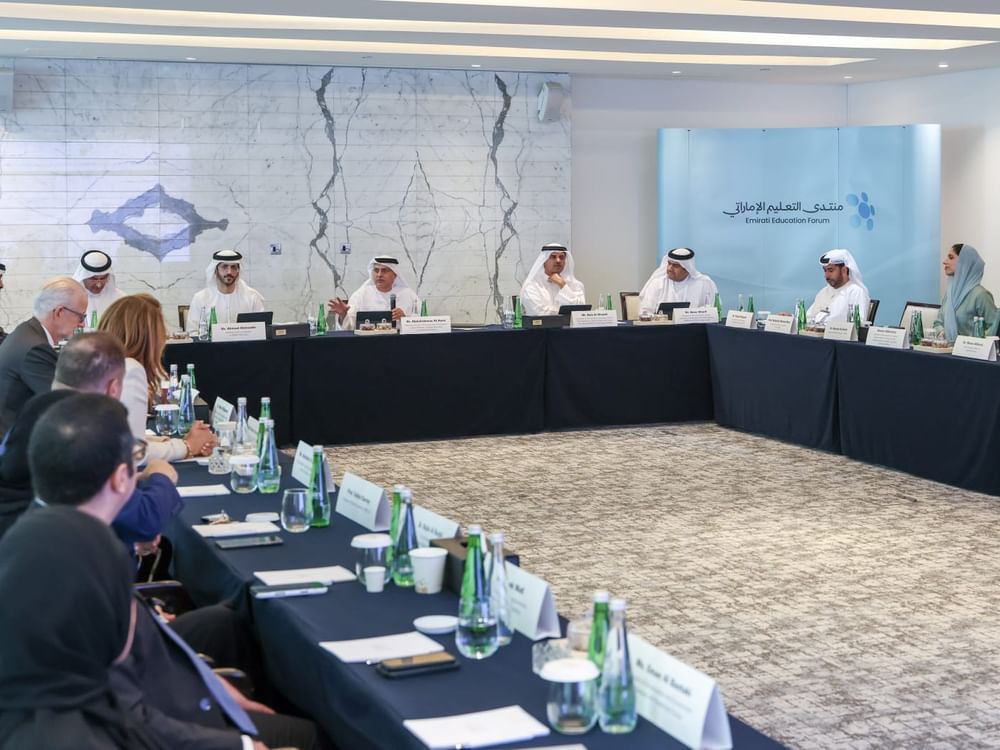
The fifth meeting of the Advisory Committee for Higher Education and Future Skills, recently held in Abu Dhabi on the sidelines of the Emirati Education Forum, highlighted significant achievements in artificial intelligence, collaboration between higher education institutions and economic sectors, and future skills development.
The meeting was chaired by Dr. Abdulrahman Al Awar, Minister of Human Resources and Emiratisation and Acting Minister of Higher Education and Scientific Research. It was attended by Committee members, heads of its working groups representing higher education institutions and vital economic sectors across the UAE, and senior officials from MoHESR.
Dr. Abdulrahman Al Awar said, "The achievements of the Advisory Committee and its working groups are aligned with the vision of our wise leadership, which places great emphasis on preparing generations capable of contributing to the knowledge economy. Collaboration between higher education institutions, government entities and private sector partners is essential to advancing shared national priorities."
He noted that the Committee provides a platform for sustained dialogue and meaningful partnerships between the higher education sector and vital economic sectors, responding to the rapid changes reshaping professions and future jobs. He emphasised the importance of translating these partnerships into tangible outcomes that enhance the quality of education, equip students with future-ready skills and strengthen higher education's contribution to the UAE's economic development.
He added, "We are building on the achievements made so far by strengthening institutional performance, accelerating the adoption of advanced technologies and expanding opportunities for applied learning, scientific research and entrepreneurship. These efforts will ensure that our higher education system is better equipped to respond to the needs of students and employers, as well as the aspirations of the national economy."
The meeting brought together representatives of higher education institutions, government entities and private sector partners, including Buti Saeed Al Ghandi, Chairman of the Board of Trustees of Canadian University Dubai; Dr. Essam Al Tamimi, Founder and Chairman of Al Tamimi & Company; Prof. Ebrahim Al Hajri, President of Khalifa University of Science and Technology; Dr. Amer Sharif, CEO of Dubai Health and President of Mohammed Bin Rashid University of Medicine and Health Sciences; Dr. Mansoor Al Awar, Chancellor of Hamdan Bin Mohammed Smart University; Dr. Faisal Al Ayyan, President and CEO of the Higher Colleges of Technology; and Dr. Ismail Matalka, President of Ras Al Khaimah Medical and Health Sciences University.
Other participants included Dr. Mariam Al Hindi, Director of Technical Excellence at ADNOC; Jean Louis, CEO of Insurance Services at PureHealth Group; Dr. Mona Al Seeni, Chief Strategy Officer at Zayed University; Dr. Mai Al Mansoori, Director of R&D Talent Enablement at the Advanced Technology Research Council; Dr. Mohammed Alameddine, Dean of the College of Health Sciences at the University of Sharjah; Dr. Rahma Bougrand, Vice President and Head of Customer Advisory and Presales at SAP; Emilio Pera, CEO and Senior Partner at KPMG Lower Gulf; Abdullah Al Zarooni, Vice President of Technology Development and Transfer at Emirates Global Aluminium; Dr. Khaled Al Saleh, Vice Chancellor for Academic Affairs at Ajman University; Dr. Fakhri Karray, Professor of Machine Learning at Mohamed bin Zayed University of Artificial Intelligence; Dr. Abdelkader Abou Safieh, Director of the Advanced Materials Cluster at Strata Manufacturing; and Dr. Tarek Wafi, Director of the Leadership Institute at Majid Al Futtaim Holding.
The meeting highlighted the plans and achievements of the Committee's specialised working groups during their first year. These efforts have helped translate collaboration between universities and private sector partners into practical initiatives, academic improvements and new opportunities for students and faculty members.
The working groups have also strengthened links between higher education and the labour market. Through the Academic Economic Sectors Immersion Programme, university faculty members gained practical experience within companies, helping integrate sector-specific knowledge and emerging workplace requirements into academic teaching.
In addition, 162 skills clusters and 170 potential opportunities for improving academic programmes were identified. These findings support universities in reviewing their curricula and aligning graduate capabilities more closely with evolving economic and technological needs.
The meeting reviewed progress in strengthening higher education data governance through the Higher Education Institutions Indicators Compass, which provides institutions with greater visibility into their data quality and performance through real-time data integration with the Ministry.
Initial results showed significant improvements, with the quality rate of critical data rising from 68 percent to 86 percent, reflecting positive progress in data reliability and efficiency. These developments reflect the Ministry's commitment to a more integrated, transparent and outcomes-based approach to higher education governance, supported by reliable data and continuous institutional improvement.
The Committee explored opportunities to strengthen entrepreneurship education and support students in transforming innovative ideas into scalable businesses.
The meeting reviewed a proposal to develop entrepreneurship education with greater emphasis on practical experience, projects addressing real-world challenges, business development and collaboration with investors and start-up ecosystems. This approach aims to help students develop entrepreneurial capabilities alongside their academic studies while building stronger connections between universities and the UAE's wider innovation and business ecosystem.
The meeting reviewed the implementation of new national frameworks and regulatory resolutions issued by the UAE Cabinet to strengthen the governance, quality and competitiveness of higher education institutions.
Members also discussed the latest developments relating to the inaugural UAE Award in Higher Education. The award aims to recognise excellence, innovation, institutional leadership, transformative projects and impactful partnerships, while encouraging higher education and scientific research institutions and their partners across economic sectors to contribute more effectively to national development priorities.
Looking ahead, the Committee discussed a proposal to restructure its working groups and move towards a more sector-focused model covering 12 priority sectors, alongside a cross-sector working group dedicated to scientific research, innovation and the commercialisation of research outcomes.
The proposed model seeks to build on the achievements of the existing working groups by strengthening engagement with employers, validating future skills requirements, expanding practical training opportunities and encouraging joint initiatives in scientific research and entrepreneurship.
The Ministry reaffirmed its commitment to working closely with higher education institutions and private sector partners to translate these priorities into measurable outcomes, further strengthening the UAE's position as a leading destination for higher education, scientific research and innovation.