
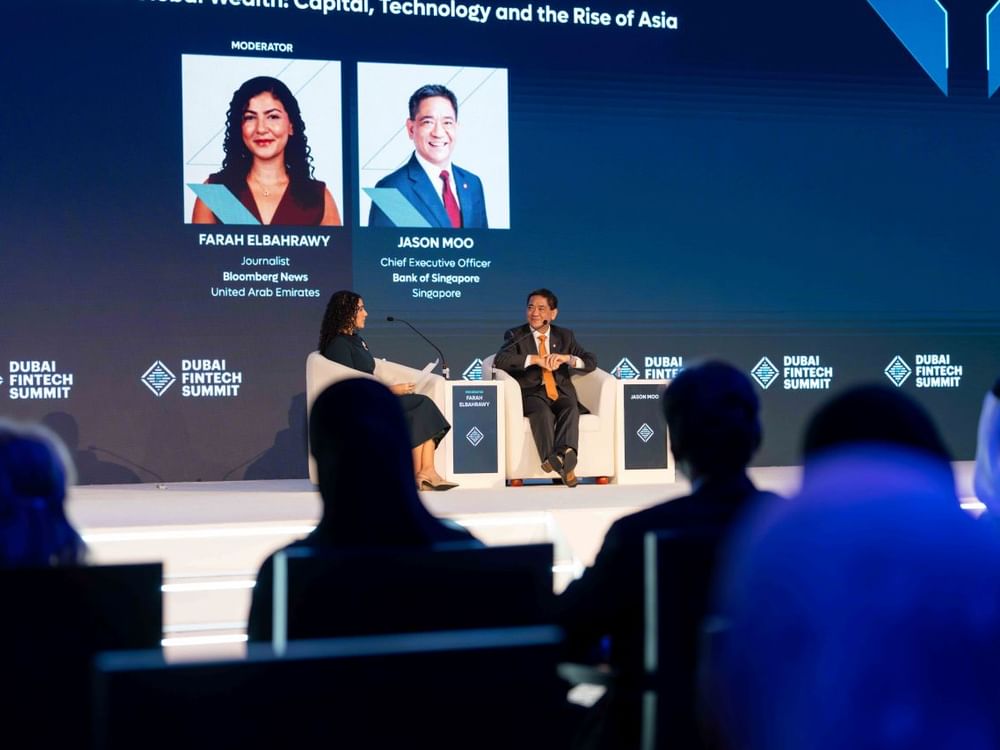
DUBAI, 5th November, 2026 (WAM) -- Bank of Singapore CEO Jason Moo took part in A New Era for Global Wealth: Capital, Technology and the Rise of Asia, a one-on-one fireside chat at the Dubai FinTech Summit, sharing the bank’s perspective in a city central to its Middle East business.
During the session, held at Madinat Jumeirah on day one of the summit, Moo discussed Dubai and Singapore’s complementary roles as wealth hubs, growing investment links between Asia and the Middle East, and how AI is changing private banking.
Moo described Asia as “a source of capital and a source of investment,” with wealth being generated in the region while international clients increasingly look there for opportunities. He said he had seen more international clients over the past five years, although Asian clients still make up the majority. As clients diversify where their assets are held and managed, he sees room for both Singapore and Dubai to grow over the coming decade.
“There is no cannibalization. There’s enough wealth around the world to really be managed in different locations,” he said. Dubai’s geographical accessibility between Asia and Europe, the development of technology and investment ecosystems around DIFC, and growth prospects across the GCC and Indian subcontinent all contribute to its appeal, Moo explained.
Dubai is one of Bank of Singapore’s three strategic hubs, alongside Hong Kong and Singapore itself. Its DIFC branch, which serves clients in the Middle East and Europe, continues to add bankers to its team. The bank has observed rising interest from Chinese conglomerates and investors in wealth and investment opportunities in Dubai.
To support this, it has organised visits to Dubai for investors and senior financial institution executives from China, while its DIFC branch provides dedicated Chinese coverage to serve this expanding client segment.
Moo pointed to a similar trend among Middle Eastern clients, who are looking to Asia for custody and investment opportunities, highlighting interest in the markets of the Association of Southeast Asian Nations (ASEAN). “I really feel like that’s where the next alliances will be built,” he said of the Asia-Middle East corridor. The bank can draw on parent company OCBC Group’s network across Greater China and ASEAN to support clients exploring these markets.
Family offices’ investment needs are also changing. Moo described increasingly institutional approaches to allocation and diversification, placing greater demands on private banks. “We have to offer them everything from public to private opportunities,” he said. He touched on clients’ interest in private market opportunities in AI and its supporting infrastructure, including data centers, cooling, and energy.
AI is also helping the bank streamline its onboarding process. “We developed our own AI agents to do KYC for clients,” Moo said, referring to know-your-customer checks. The technology collects data, generates reports, and helps accelerate due diligence. Accounts can now be opened in 15 business days, half the current industry median of about six weeks.