
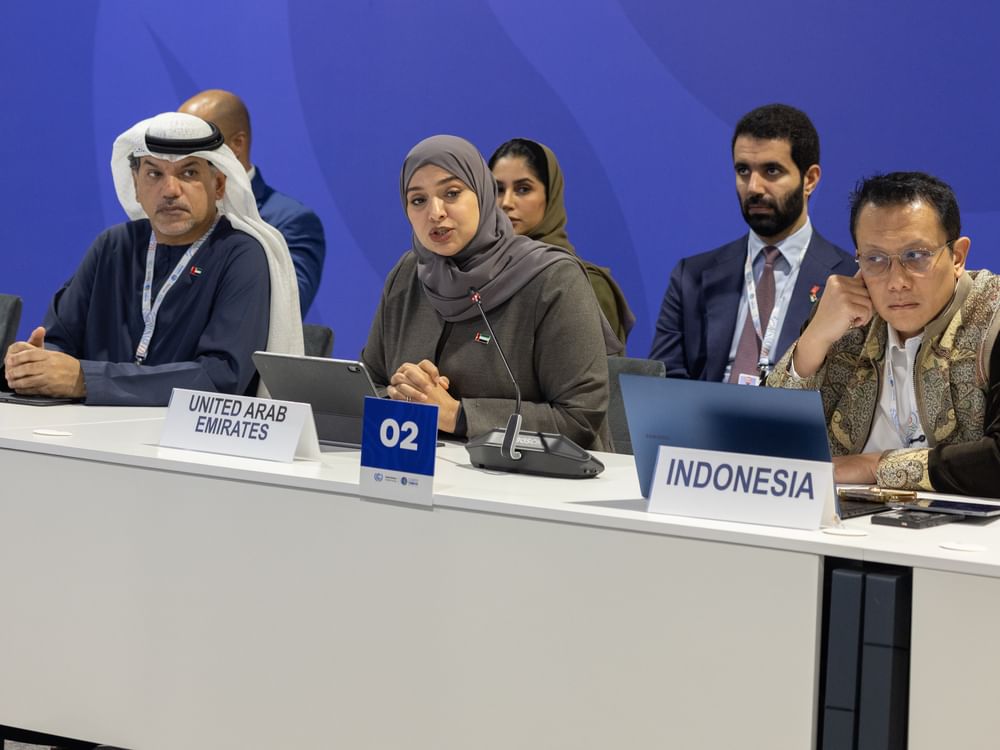
ANTALYA, 22nd November, 2026 (WAM) -- The UAE, in its capacity as co-chair of the Mangrove Alliance for Climate, proposed developing a work programme to implement the alliance’s 2031 Strategy. It also called for scaling up nature-based climate solutions by sharing expertise and making advanced technologies available to member countries to conserve and rehabilitate mangrove forests.
The UAE put forward the proposals at the Fourth Ministerial Meeting of the Mangrove Alliance for Climate (MAC), held in Antalya, Türkiye, on the sidelines of the 31st session of the Conference of the Parties to the United Nations Framework Convention on Climate Change (COP31).
Dr. Amna bint Abdullah Al Dahak, Minister of Climate Change and Environment, co-chaired the meeting alongside Diaz Faisal Malik Hendropriyono, Deputy Minister of the Environment of the Republic of Indonesia. Ministers and heads of delegation from member countries and representatives of partner organisations participated in the meeting.
The UAE provided an update on its national efforts, including the planting of more than 75.6 million mangrove trees, representing 75.6 percent of its national target of planting 100 million trees by 2030. These efforts support the UAE’s goal of achieving net zero by 2050 and the objectives of its National Biodiversity Strategy 2031. The update also covered the use of AI-powered drones for aerial seeding in hard-to-reach coastal areas.
In her opening remarks, Dr. Al Dahak underscored MAC’s focus on achieving tangible results in mangrove conservation and rehabilitation. She said, “When we launched MAC with Indonesia in Sharm El Sheikh in 2022, our aim was to put mangrove forests at the heart of global climate action. Since then, we have broadened international cooperation, and we are now moving to implement our 2031 Strategy.
Protecting and rehabilitating our mangrove ecosystems is central to safeguarding coastal biodiversity. By expanding these natural buffers, we help vulnerable communities adapt to climate impacts, regenerate habitats that sustain local fisheries, and secure indispensable blue carbon reserves to ensure a resilient, thriving future for our marine heritage.”
She added, “As Co-Chair of the Alliance, the UAE is advancing three priorities for this phase. The first is to develop a work programme that helps member countries deliver on their national climate and biodiversity commitments. The second is to make advanced technologies and applied research findings available to teams working on mangrove rehabilitation, so they can use AI and data to select sites and track results. The third is to deepen cooperation with global initiatives, foremost among them the Mangrove Breakthrough, to expand mangrove rehabilitation efforts and make progress easier to track.
The UAE is bringing its experience in rehabilitating mangrove ecosystems to this cooperation and is working with local authorities, research institutions, youth and communities to expand these efforts and share the lessons learned with member countries.”
In his speech, Hendropriyono said, “Indonesia has the world’s largest mangrove area, with approximately 3.46 million hectares recorded in our 2025 National Mangrove Map. Managing this asset requires looking beyond the coastline, which is why we adopted a landscape-based approach across seven ecoregions. But policies alone are not enough. Planting trees does not always mean that an ecosystem has recovered. We have also strengthened our regulatory framework and adopted national plans to coordinate mangrove protection, rehabilitation and blue carbon management.”
He added, “To translate ideas into practical action, we are establishing the International Mangrove Research Centre in Bali with the UAE as a hub for joint research and knowledge exchange. Building on this, Indonesia welcomes closer collaboration within the Alliance in three areas including stronger scientific cooperation to guide landscape decisions, technology exchange and mangrove rehabilitation projects in developing countries, and predictable, blended financing and blue carbon mechanisms that uphold environmental integrity and deliver fair benefits to local communities. We need to measure our progress by how much habitat we safeguard and rehabilitate.”
The meeting reviewed the progress of the alliance, which has 48 members, including 47 countries and the Secretariat General of the Gulf Cooperation Council. The updates covered the exchange of expertise in supporting mangrove growth in arid and highly saline environments. The meeting also discussed preparations to launch the alliance’s updated website to make its resources easier for members and partners to access.
The updates announced at the meeting included a collaboration agreement between Nabat and Indonesia’s Coordinating Ministry for Food Affairs. The agreement was signed on the sidelines of COP31 on 13th November 2026 in Antalya. Nabat is an Abu Dhabi-based nature technology company and part of the Advanced Technology Research Council (ATRC) ecosystem.
The agreement paves the way for two pilot initiatives to improve mangrove ecosystem management in Demak, Central Java. The first pilot uses AI, satellite imagery and more than 20 environmental predictors to identify and prioritise the sites most suitable for mangrove rehabilitation. The second combines drone-based LiDAR surveys, field measurements and soil sampling to establish a field-validated baseline for mangrove carbon stocks.
The collaboration involves Indonesian technical and academic partners and includes training for teams from institutions and coastal communities in field data collection. Nabat is exploring opportunities to apply this approach with other members in line with their national priorities and the environmental characteristics of their rehabilitation sites. The meeting also discussed plans for the Mohamed bin Zayed–Joko Widodo International Mangrove Research Centre in Bali. The centre, whose foundation stone was laid in 2024, is intended to support joint research and develop methods for rehabilitating tropical coastal ecosystems.
In a session dedicated to the Mangrove Breakthrough, the initiative’s Executive Director and Global Ambassador outlined opportunities to align its work with MAC’s priorities and scale up investment in mangrove protection and rehabilitation. The Mangrove Breakthrough was launched on the sidelines of COP27 through a collaboration between the Global Mangrove Alliance and the UN Climate Change High-Level Champions. The UAE endorsed the initiative in 2023. The Mangrove Breakthrough aims to mobilise US$4 billion to protect and rehabilitate 15 million hectares of mangrove forests worldwide by 2030 by halting net mangrove loss, rehabilitating at least half of recently degraded areas and doubling the area under protection.
According to the initiative’s Financial Roadmap Progress Assessment, released on 12th November 2026, the Mangrove Breakthrough tracked more than 40 major transactions that collectively mobilised nearly US$1 billion in investments supporting mangroves since 2020. Its project portfolio identifies opportunities across more than 300 sites in around 50 countries, covering over 500,000 hectares of mangrove ecosystems.
The Fourth Ministerial Meeting of the Mangrove Alliance for Climate included a session on Japan’s contribution, in which representatives of Japan’s Ministry of the Environment and the Japan International Cooperation Agency (JICA) outlined opportunities for cooperation in environmental monitoring, knowledge exchange and capacity-building. By bringing partners together and matching their needs with opportunities for cooperation, the UAE is spearheading cooperation with Indonesia and Japan to strengthen the capacity of the Mangrove Information Centre in Bali in ecotourism, aquaculture integrated with mangroves and carbon monitoring.
During the high-level MAC Member Country Interventions session, one of the highlights of the meeting, delegations from across the globe delivered official statements on their national efforts to conserve and rehabilitate mangrove forests. They reviewed progress since COP30, shared experience in managing coastal habitats and identified priorities for deeper multilateral cooperation, including areas for technical and scientific cooperation and opportunities to support national projects through the alliance. Representatives and senior officials from Europe, Asia-Pacific and the Middle East underscored their shared commitment to safeguarding coastal ecosystems and scaling up nature-based climate solutions.
Catherine Chabaud, Minister Delegate for the Sea and Fisheries of the French Republic, reaffirmed France’s commitment to continuing its diplomatic leadership in global biodiversity and nature negotiations. Steven Victor, Minister of Agriculture, Fisheries and the Environment of Palau, and Thoriq Ibrahim, Ambassador of the Republic of Maldives to the UAE and former Minister of Climate Change, Environment and Energy, highlighted the challenges facing small island developing states on the front lines of climate change. They called for urgent collective action to strengthen coastal resilience, protect marine ecosystems and conserve mangroves.
Dr. Nani Hendiarti, Indonesia’s Deputy Coordinating Minister for Food Accessibility and Safety, shared Indonesia’s continued progress in driving large-scale sustainable mangrove management and rehabilitation. Nouf Behbehani, Acting Director-General of Kuwait’s Environment Public Authority, and Dr. Thuraya Al Sariri, Adviser for Nature Conservation to the President of Oman’s Environment Authority, highlighted regional efforts in coastal management and conservation, mangrove rehabilitation in arid environments and environmental governance across the Arabian Peninsula.
The Acting Director-General of the International Affairs Bureau at the Korea Forest Service presented the Republic of Korea’s ongoing initiatives and contributions to cross-border forest and ecosystem conservation partnerships.
The floor was then opened to the other member delegations, with interventions from representatives of Germany, the United Kingdom, Mauritius, Sri Lanka and Bangladesh, as well as Kuwait and Bahrain. The interventions reflected the unity of the member countries’ efforts across regions and showed that cross-regional cooperation under the Mangrove Alliance for Climate is stronger, more coordinated and more ambitious than ever.
The UAE and Indonesia launched the Mangrove Alliance for Climate in 2022 on the sidelines of COP27 in Sharm El Sheikh. The alliance aims to strengthen international cooperation in conserving, rehabilitating and sustainably managing mangrove forests, one of the most important nature-based climate solutions, and to support scientific research, capacity-building and knowledge exchange. The UAE unveiled the MAC 2031 Strategy at the alliance’s Second Ministerial Meeting on the sidelines of COP29 in Baku in 2024.
Mangrove forests store carbon in their trees and the sediments beneath them, making them one of the most important coastal blue carbon ecosystems. They also reduce the impact of waves and storms, limit shoreline erosion and provide habitats for juvenile fish and crustaceans. These functions support coastal livelihoods, climate adaptation and climate change mitigation.